A mite early for the romantic occasion, but, for those seeking a partner online, this grammar advice may be timely. And, better to be prepared than to wait until the last minute! As a happily married man I have no need of such services, but this modern age seems to create lives with little time …
Tag: Writers Resources
Cut The Fat; Make Your Writing Lean: #Tip 32
We writers tend to enjoy sharing ideas to improve our craft. Here are some ways to trim our writing. Readers will appreciate us removing these common redundancies and flabby expressions. Completely filled: When something has been filled, it is full, so ‘completely’ is redundant. e.g. She blew up the beach ball until it was completely …
Continue reading Cut The Fat; Make Your Writing Lean: #Tip 32
False Starts and a Solution?
How many times should you start a writing project? Odd question? Well, I normally have my books ready in my mind, that is, I know where I want to end up even if I don’t know the route, long before I place a single word on paper (for which, read ‘screen’, since I compose at …
Name a Character in my New Novel.
Characters are fundamental to my stories, as readers will know. I’m in the initial stages of writing a new science fiction novel, set on Mars. For a while, I’ve been beset by a mysterious barrier to getting on with the story. Lots of preparation, research, and reading round essential topics of interest. And I have …
Cut The Fat; Make Your Writing Lean: #Tip 31.
Writers enjoy sharing ideas to improve their craft. Here are some ways to trim our writing. Readers will appreciate us removing common redundancies and flabby expressions. Completely engulfed: When something is engulfed, it’s completely enclosed in whatever is engulfing it, so ‘completely’ is a tautology. e.g. The flames completely engulfed the high rise building. Try: …
Continue reading Cut The Fat; Make Your Writing Lean: #Tip 31.
Amazon: a Solution to the Review Problem?
Perhaps, Amazon can be persuaded to do something positive for authors who provide it with a living? The company currently has a policy preventing honest reviews from writers giving opinions on the books of other writers they may know. The whole policy is a sledgehammer to crack a walnut. It’s intended to prevent dishonest reviews …
Cut The Fat; Make Your Writing Lean: #Tip 30.
Writers enjoy sharing ideas to improve their craft. Here are some ways to trim our writing. Readers will appreciate us removing common redundancies and flabby expressions Completely eliminate: To eliminate is to remove entirely, so ‘completely’ is superfluous. e.g. If you want your dog to really love you, completely eliminate all competition for your attention. …
Continue reading Cut The Fat; Make Your Writing Lean: #Tip 30.
The Mother Tongue, by Bill Bryson, Reviewed.
Subtitled, ‘English and How it Got That Way’, this is typical Bryson wit and erudition at his best. I confess, I was tempted initially to disagree with some of his numbers on the speaking of English, but a quick gander at Google soon put me right on that issue. The book is divided into 16 …
Continue reading The Mother Tongue, by Bill Bryson, Reviewed.
Cut The Fat; Make Your Writing Lean: #Tip 29.
Writers enjoy sharing ideas to improve their craft. Here are some ways to trim our writing. Readers will appreciate us removing common redundancies and flabby expressions. Completely destroy: If you destroy something, it is shattered, demolished, pulled to pieces: in any case, it ceases to exist as it was before the act. ‘Completely’ is therefore …
Continue reading Cut The Fat; Make Your Writing Lean: #Tip 29.
Cut The Fat; Make Your Writing Lean: #Tip 28.
Writers enjoy sharing ideas to improve their craft. Here are some ways to trim our writing. Readers will appreciate us removing common redundancies and flabby expressions. Commute back and forth: You commute to get to and from work, so ‘back and forth’ is unnecessary. Unless, of course, you have the sense to live close to …
Continue reading Cut The Fat; Make Your Writing Lean: #Tip 28.
You can’t tell me what to do!
I agree with almost everything Dr Meg Sorick says here. Great piece that new writers in particular might want to read. Mind you, there are a few experienced writers who would benefit from this advice too!
I came across this photo/list of Elmore Leonard’s Ten Rules of Writing on Pinterest. It’s an excerpt fromhisessay of the same title. I thought it would be interesting to see if you all agree or disagree with these rules.
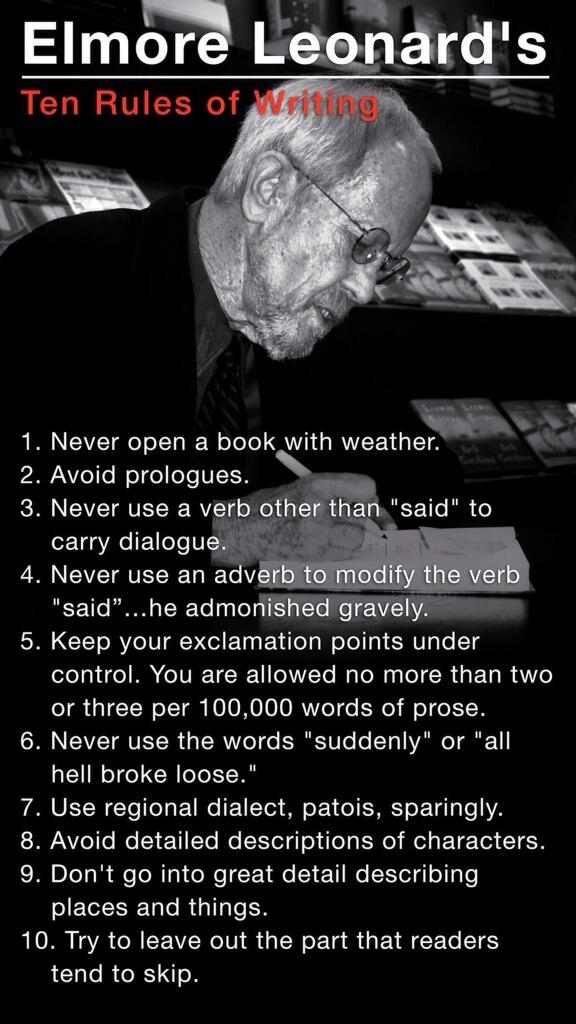
Here’s my opinion:
1. Personally, I love a story that starts with “It was a dark and stormy night…” (just kidding, unless the author is trying to be ironic).
2. How about the prologue? Is there a bit of the story that just needs to be set off by itself? I’m pretty sure I’ve never had a problem with a prologue.
3.”Said” seems to have no grey area. Writers either demand that “said” be used exclusivelyor they hate having to stick to “said.” Some say it’s the mark of an inexperienced writer to use words other than “said.” Whatever. Sometimes, words like “whispered,” “murmured,”or “shouted” just need to be used, I…

View original post 272 more words
Updated Writing Contests Page
Just a quick message to know the table has been updated and you'll find it here. Good Luck!
Cut The Fat; Make Your Writing Lean: #Tip 27.
Writers share ideas to improve their craft. Here, I'm looking at ways to trim our writing. Readers will thank us for removing common redundancies and flabby expressions. Close proximity: Something in proximity to something else is close to it, so ‘close’ is a tautology. e.g. The close proximity of the backpacker caused the tourists to …
Continue reading Cut The Fat; Make Your Writing Lean: #Tip 27.
Cut The Fat; Make Your Writing Lean: #Tip 25.
Writers share ideas to improve their craft. Here, I'm looking at ways to trim our writing. Readers will thank us for removing common redundancies and flabby expressions. Careful scrutiny: Scrutiny is the careful examination of something, so ‘careful’ is a tautology here. e.g. Susan read the contract with careful scrutiny. Try: Susan read the contract …
Continue reading Cut The Fat; Make Your Writing Lean: #Tip 25.
Cut The Fat; Make Your Writing Lean: #Tip 23.
We writers like to share ideas to improve our craft. Here, with a slightly seasonal slant, I'm looking at ways to trim our writing. Readers will thank us for removing common redundancies and flabby expressions. At the present time: Empty words; avoid them. e.g. At the present time we all want to wish each other …
Continue reading Cut The Fat; Make Your Writing Lean: #Tip 23.