
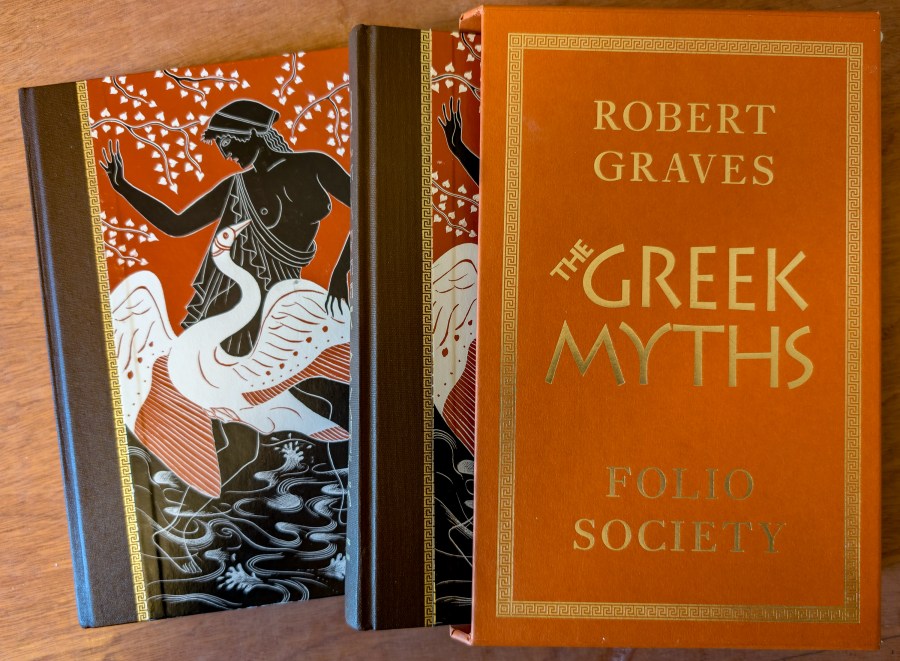
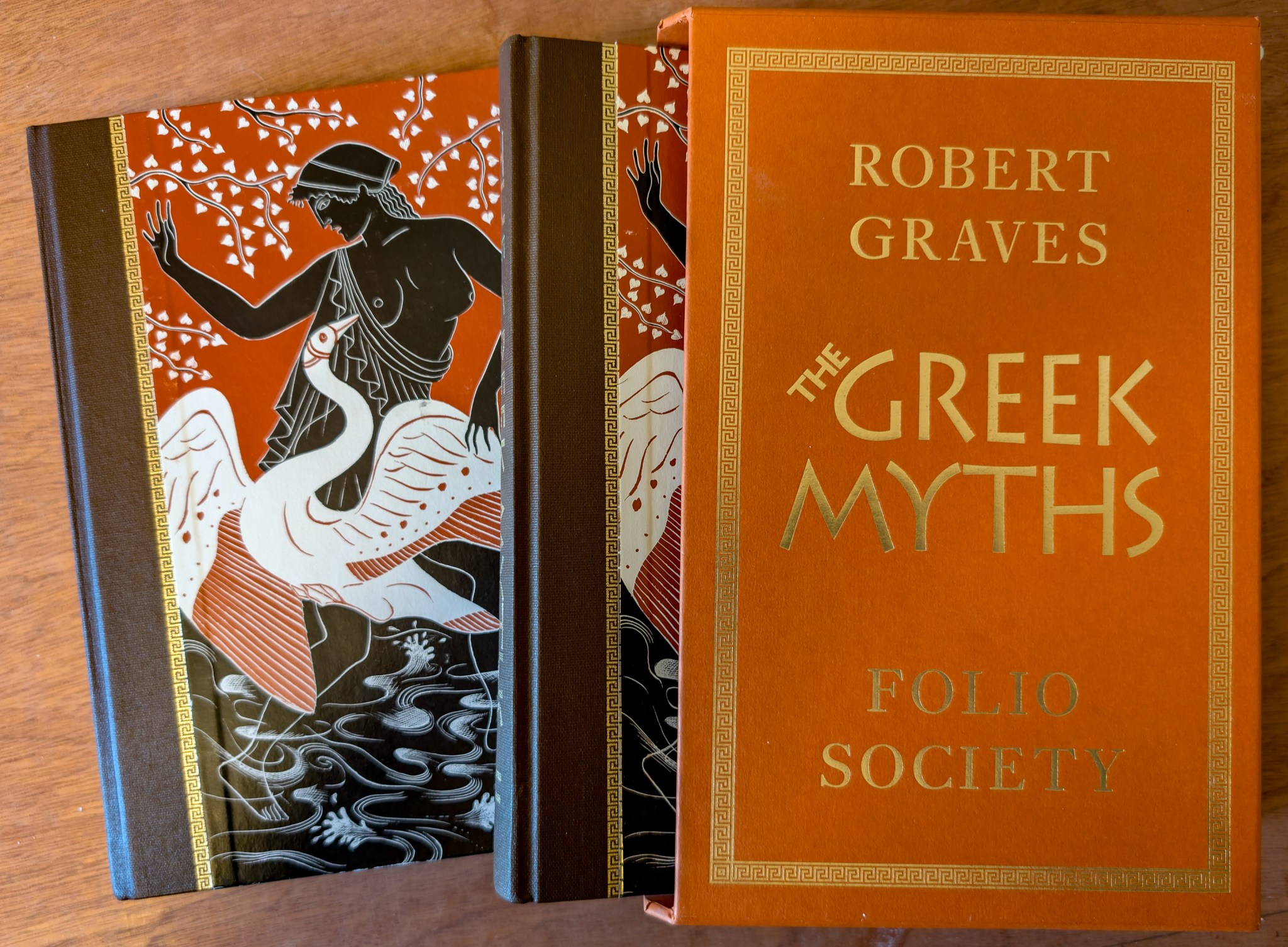
The edition of this book that I read is the two-volume hardback from the Folio Book Club. It is illustrated and very well presented, making it a pleasure to hold and behold, but the content is the same as that published in the ordinary single volume.
The Greek Myths: what a tangled web of history, conjecture, literary theft, overlapping accounts, extremes of imaginative speculation and downright fantasy these are. I mean by that the content of the myths, not Robert Graves’ scholarly reproduction and examination of the stories. His introduction places the tales within a context that allows readers to comprehend the multiple origins of the legends, and the ways in which they have been allowed to develop over a long period.
It’s clear the myths were the outcome of an attempt to understand and even explain events, attitudes, and actions that must have seemed otherwise incapable of comprehension by the people of the times during which they were created, and that creation seems to have begun sometime around 2000BC. As moral standards altered with time, location of the various authors, philosophical re-examinations, and the ambitions of those then in charge of the societies involved, so the nature of the myths was altered, sometimes subtly and at others very crudely.
During the emergence of any civilisation stories of origin, heroics, ambition, and mystery inevitably emerge. Almost every religion is the child of such ruminations by early tale-tellers who had little science or written history to guide their narratives and, at a time when superstition, the offspring of ignorance, must have been ripe, it is hardly surprising many events were invented that have little or no connection with reality. It is clear that many of these stories originated in lands other than those occupied by the Greeks. Some travelled great distances, in the times before writing was created and understood, probably via the imaginative re-telling of folk tales by merchants and itinerant travellers. Such stories were often originally devised by the creative servants of powerful leaders as a method of both informing the common people and controlling them to ensure they conformed to the behaviour required by the leader.
The myths, detailing the actions of the invented deities, of which there were many, report bullying, cheating, lying, sexual assault and rape, murder, torture, and injustice committed by these various objects of worship. They could, of course, also be generous, kind, caring, and even loving, though much of that more positive behaviour seemed so often confined to their fellow deities rather than to their worshippers. It creates a situation that suggests worship was the result of fear rather than devotion, as seems to be the case for many even today.
My understanding is that these myths, included as they are in what is loosely termed the ‘Classics’, have been taught to children, especially those who attend private education, the suggestion being that the tales were presented as good examples. That would certainly explain the otherwise often inexplicable actions and attitudes of many leaders.
I discovered in reading the book I was visited with that same sense of appalled disbelief I felt when I read the Bible from cover to cover the first time. That so much injustice, cruelty, prejudice, and indifference could be presented as acceptable simply because those committing the actions were considered deities, profoundly affected my reading of these tales. I emerged from the experience both enlightened and deeply disturbed that humanity has so often positively based heroic literature on the cavalier actions of selfish, uncaring and violent beings.
An informative and educational roller coaster of a read!
[Any review is a personal opinion. No reviewer can represent the view of anyone else. The best we can manage is an honest reaction to any given book.]

 Stuart Aken
I am one of those who took “Classics” and just about drowned in all those myths. Interesting, but certainly not as exemplars! What was more interesting to me was the way in which these stories lead to a study of the psychology of human behaviour (as the bible did also). Unfortunately, not much has changed. Donald Trump thinks he’s Zeus.
LikeLiked by 2 people
Brilliant, Lynette! I agree. The orange disaster certainly shows signs of, shall we say, considerable self-aggrandisement in relation to his power and intellect?
LikeLiked by 2 people
Thanks, Stuart. Disaster is exactly the right word for him. No doubt he’s up prowling around right now, hallucinating about gladiatorial contests.
LikeLiked by 2 people
Delusions of grandeur are, of course, common in those who aspire to be leaders. Unfortunately, our society is rigged in such a way that it is so often the most unsuitable people who actually take on those vital roles, and, almost without exception, make an utter mess of it!
LikeLiked by 2 people
Yes, they definitely are! I agree that it’s usually the most unsuitable who wind up in power and yes, then make an utter mess of it because basically they’re often too stupid to realise exactly how unsuited they really are. Ugh.
LikeLiked by 2 people