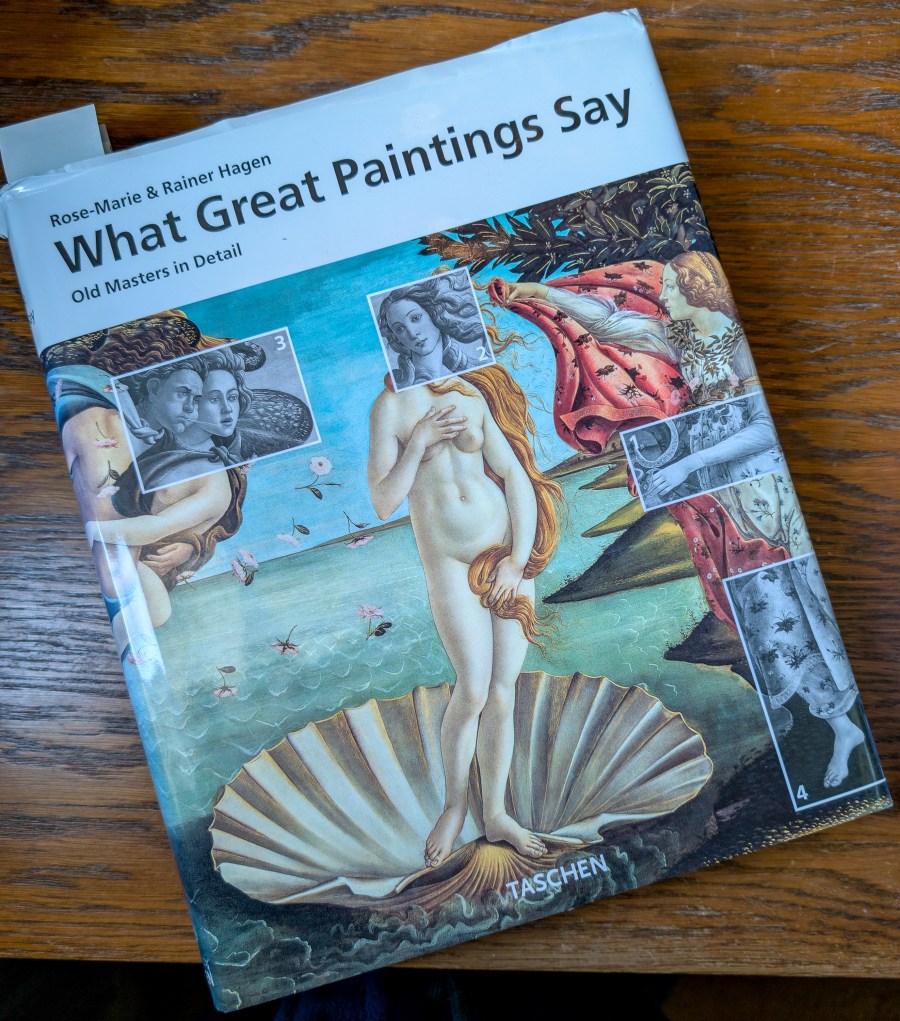

This 500-page encyclopaedic tome is one of a set of art books I was given by a kind and generous stranger, a woman neighbour from a nearby village. I’m conducting research for a novel, and the visual arts feature significantly in the story. Whilst I have some knowledge of the art world, working as a photographer for many years and, for a few short years, employed as a graphics technician in an art college, I lack the necessary academic background to deal with this complex aspect without some help from those who know.
The history of art is a complicated subject, open to many interpretations and often lacking much of the fact that might truly explain the origins of a painting. Much, this book explains, depends on the period during which a painting was made, but its content, and therefore its meaning is also very much dependent on the views and aims of its sponsor.
In the past, as now for some art, pictures were commissioned by the very wealthy. Almost always by men. Their wealth seems to have endowed them with undeserved respect and allowed early scholars to praise their ‘taste’ well beyond the realities of the situation.
The authors of this extraordinary piece of work have tried to discover valid sources of information, and taken into account the prejudices, priorities, and levels of knowledge prevalent at the time of creation of the works they examined. Finding the truth relating to each painting’s meaning is therefore somewhat akin to building a three-dimensional chess board and its pieces out of string, paper and ice-cream. That they’ve managed to reach conclusions on certain pieces is an indication of the depth and breadth of their research.
I have learned much about what some paintings may mean by reading this comprehensive tome, but remain uncertain just what level of credibility can honestly be given to the conclusions in all cases. It’s true the authors have made their doubts and uncertainties clear, so the reader is left with at least an impression of the meanings of some very famous and some less well-known paintings.
I’ve been selective in my reading of the book, because only certain subjects are of significance to the novel I’m writing, and that may have meant my understanding of the views, histories, and comments relating to those works of art are not necessarily representative of all the many paintings examined in the book.
My reading, nevertheless, has proved a valuable exercise and has certainly rewarded the effort and time by providing me with enough information, mood, and context to effectively include the subject in my current piece of fiction. So, my thanks and admiration go to the authors, without whose work I would either have remained in the dark or, a decidedly unacceptable alternative, independently come to conclusions filled with either irrelevance or inaccuracy, or both!
[Any review is a personal opinion. No reviewer can represent the view of anyone else. The best we can manage is an honest reaction to any given book.]

 Stuart Aken
Nice to credit those who help. I couldn’t do without some of the instructional art books that I have that have helped me attempt to master my profession. You have an eye catching and well designed newsletter Stuart. Thank you.
John
LikeLiked by 1 person
Thank you, John. I’ve been a photographer since my dad gave me a folding camera for a good school report when I was about 12. And my mother was a gifted painter who won a scholarship at the Slade school of art but whose father prevented her attending. She used to paint in oils on the rough back of sheets of hardboard, and i was always fascinated to watch her work, so perhaps I gained some visual insights there.
LikeLike
it’s the artistic gene!
LikeLiked by 1 person
Could well be!
LikeLike
It looks like a wide-ranging subject, Lynette. The more I learn about it, the more intrigued I become.
LikeLiked by 1 person
I took an art history class, and it was wonderful. However, there is still so much left to learn. It barely scratched the surface. I’ve been meaning to find an art history book, I’ll give this book a try. Thank you for sharing.
LikeLiked by 1 person
This particular edition was published in 2000, Lina, so you’ll probably only find a used one. It was a gift, and provided the information I needed, so the publication date was of little relevance to me.
LikeLiked by 1 person
I took one art history course as an elective in uni and enjoyed learning about how artistic expressionism has changed over the millennia.
LikeLiked by 1 person