
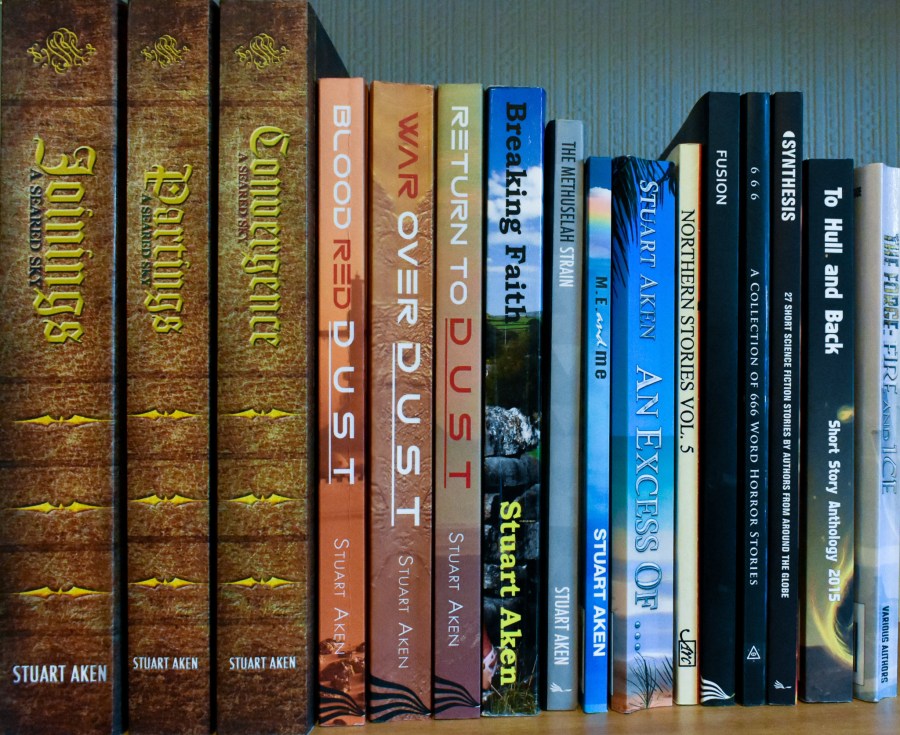

This is an update on a post I placed on Medium called ‘Searching On Amazon’
I’d found a book on Goodreads that seemed something I might be interested in, so I used Goodreads’ buying link to take me to it on Amazon. It took me nowhere near the book I wanted. So, I searched for the book by its title and had to plough through three pages to find the only book listed with that exact title. As an experiment, I did a search for the same book, later on the same day, and it still failed to appear on the first page, so there’s clearly no ‘customer memory’ on the site. A part solution arises if I search under the author’s name, but it’s not perfect, since some writers use the same name as others and some authors produce vast lists of books.
Why use Amazon at all for books? Well, they associate reviews with purchases. A ‘verified purchase’ review carries more weight than a review done without purchase. Reviews get books noticed, and with 2,000,000 new titles published each year, those books we care about definitely need help to be noticed.
But why is it so hard to find a specific title on Amazon?
You look for a book, using that specific title. You enter a precise title in the search box on Amazon. Does that book appear as the first item listed? In fact, does it even appear on the first of the 73 pages supplied? Most of the time it does not, unless it’s a ‘best seller’.
Why? I’m searching for a specific book, I’ve supplied its name, I expect to be directed to that book.
If I go into a bookshop and ask for a book by title, I’ll be directed to the bookcase, maybe even the shelf where it’s displayed. Simple. In some cases, the seller will even find it for me. What they won’t do is send me on a fruitless search of their shop in the hope I might buy something else.
So why is Amazon incapable of pointing me to the book requested? I’m not shopping for something generic, not in search of potatoes or printing paper. A book is a very specific item. Though, of course, I accept there may be others bearing the same title. Fine. Let me have a list of those first. But I’m looking for something specific, so I don’t need variations on the title, or books that happen to have one word of my search in their title. It must be easy to satisfy such a simple request.
Since they obviously don’t do what the customer wants, there must be an ulterior motive. Is their algorithm set to place the book that’s most profitable to Amazon at the head of the list? If so, that’s a form of selective promotion that immediately alienates me as a book buyer. I suspect it does the same for most of us who seek books.
Amazon is almost entirely about profit, so it’ll always put that element first. But it does their millions of customers no service. So, Amazon, please fix your self-serving algorithm to serve the customer instead and list searched-for books by title first. It’s not a lot to ask, is it?
By the way, I do, of course, also post my reviews to Goodreads, the site for readers, to my FaceBook Author page, to my own website, and I post links to that on Twitter.

 Stuart Aken
Interesting to learn, through the comments to main argument, that we can in fact post reviews of books on Amazon even if we haven’t bought them there, as long as we are Amazon customers. I have now copied over some of my reviews of fellow Fantastic Books authors from Goodreads to Amazon and they have been accepted, along with some books from other publishers so it doesn’t look like I’m just promoting FB books. Yes, it’s all a capitalist monopoly that at the moment we have no choice but to engage with (certainly as small books publisher authors or buyers), but if may help raise the profile of authors who are not backed by a huge marketing machine.
LikeLiked by 1 person
It’s infuriating. I’m the only D. Denise Dianaty. Folks who’ve looked say the can’t find me on the first results.
LikeLike
Oh well, there are sooooo many books and similar titles, I would only rely on the ISBN.
LikeLiked by 2 people
A good suggestion, Christine. Unfortunately, the information I’m supplied with doesn’t always include that unique identifier.
LikeLike
Good points, Stuart, except one correction: “verified purchase” is not related to any specific purchase, much less the book being reviewed. It is supposed to keep people who haven’t purchased anything in Amazon (are there any left?) from posting reviews. What the point of that is, no one knows. Furthermore, we can post reviews if we got the book for free, from a giveaway or library or friend, as long as we are an Amazon customer. Best to you. Sally
LikeLiked by 1 person
Thanks, Sally. I understand your point about the ‘meaning’ of a verified purchase review. I review every book I read on Amazon, whether or not I’ve purchased the item from them. But it is clear that ‘verified reviews’ attract more prominence than those not ‘verified’. I know I can’t post to any of the national Amazon sites unless I spend a specified amount (last time I looked it was $50 for the US one), so I post only to the UK site now. These sort of restrictions and practices are just one more reason why we should do away with the entire idea of capitalism, as that priority given to making profit stems from that system, of course.
LikeLiked by 1 person
Amazon (Goodreads is a subsidiary) owner Jeff Bezos also has a huge stake in Google, so taken together, it’s a conglomerate with what amounts to a near-monopoly. As a result, they don’t need to care about customers except to get you to make purchases.
I now avoid both Google and Amazon as it was startling to realise that after I booked some travel (completely separate from them) they were tailoring their advertising on the basis of my trip. I constantly check the privacy settings on my phone and computer and update them to thwart their spying (that’s really what it is). I used to use Goodreads but unfortunately, not any more.
Good luck with this issue, Stuart.
LikeLiked by 1 person
Thanks for this, Lynette. I was aware of the link between Amazon and Goodreads, of course, but not of that between Amazon and Google. As I use Google Mail, it’s difficult for me to avoid it, which, of course, is their plan. Goodreads is not strongly connected with Amazon, as I understand it. They have certainly kept their own identity, working methods, and review policies since Bezos took over.
As for the advertising issues, I think that probably applies to whatever search site you use. There are some, pretty inadequate, restrictions users can place, but they’re probably more trouble than they’re worth.
LikeLiked by 1 person
Goodreads is owned by Amazon (which is owned by Jeff Bezos) and runs under the same policies.
I use two different personal emails now, one from Microsoft and another from Apple (two other giant companies but at least not the same ones). Our company IT head has advised our employees to avoid “putting all their eggs in one basket” so to speak, to avoid privacy issues and ad targeting. I have a couple of Gmail addresses (one through WP) but I don’t use them.
LikeLiked by 1 person
I was with MS, using their Outlook, for a long time when I first started using the internet, Lynette. But it was a slow, cumbersome, and unreliable system, so I went with a couple of others and finally settled on Google for its fairly comprehensive, if sometimes slow-to-load aspects. Of course, that was a few years ago, so things may well have changed. Certainly, the concentration on advertising has increased and is now more-or-less ubiquitous; an intrusive and irritating feature of almost all online activity. I pay for my WordPress website so I don’t have to have it populated with inane adverts for products I would never support. I’m reluctant to change these days, as my email is used for so many connections and it would be a lot of work to alter those. The truth of the matter is that the IT world has us at it’s not very merciful mercy and knows we need their services if we’re to exist normally in a world now overrun by a technology that was intended to serve us but has now become our master. A bit like money, really.
LikeLiked by 1 person
I agree that it’s cumbersome to change email addresses, but Outlook has really improved (I remember when it was clunky as I had to use it for work about 10 years ago) a lot over about the last 3 years especially since we have migrated to their updated version. Really, the differences among these providers isn’t all that significant, particularly once you get away from the free versions; I just like to spread things around for privacy.
I pay for WP as well since the ads are otherwise like a plague. Agreed, it was supposed to serve us but I remember thinking at the time that it wouldn’t turn out that way.
LikeLiked by 1 person
That’s all useful, Lynette. I’m going offline for a short while, but I’ll investigate further once I’m back at the PC. Looks like it might be worth making a few changes. Thanks for that info.
LikeLiked by 1 person
Enjoy your time away. Cheers. 🙂
LikeLiked by 1 person
🩶
LikeLiked by 1 person