Cut The Fat; Make Your Writing Lean: #Tip 39.

Writers like to share ideas to improve their craft. Here are some ways to trim your writing. Readers will appreciate the removal of these common redundancies and flabby expressions. Desirable benefit: Do you know of an undesirable benefit? I thought not. e.g. What desirable benefit does a racehorse owner obtain from his horse? Try: What …

Continue reading Cut The Fat; Make Your Writing Lean: #Tip 39.

Cut The Fat; Make Your Writing Lean: #Tip 38.

As writers, we generally share ideas to improve our craft. Here are some ways to trim our writing. Readers will appreciate us removing these common redundancies and flabby expressions. Descend down: I’m fairly certain it’s not possible to descend in any direction but down, so the qualifier is not needed. e.g. The pirate captain forced …

Continue reading Cut The Fat; Make Your Writing Lean: #Tip 38.

Cut The Fat; Make Your Writing Lean: #Tip 37.

As writers, we generally share ideas to improve our craft. Here are some ways to trim our writing. Readers will appreciate us removing these common redundancies and flabby expressions. Depreciate in value: Can something depreciate in anything other than some form of value? I can’t think of anything, but by all means educate me. e.g. …

Continue reading Cut The Fat; Make Your Writing Lean: #Tip 37.

Cut The Fat; Make Your Writing Lean: #Tip 36.

We writers generally enjoy sharing ideas to improve our craft. Here are some ways to trim our writing. Readers will appreciate us removing these common redundancies and flabby expressions. The recent celebration of love via St. Valentine’s Day, that tacky, commercialised occasion much promoted by florists and the sellers of cards and chocolates, prompted me …

Continue reading Cut The Fat; Make Your Writing Lean: #Tip 36.

Cut The Fat; Make Your Writing Lean: #Tip 35.

We writers generally enjoy sharing ideas to improve our craft. Here are some ways to trim our writing. Readers will appreciate us removing these common redundancies and flabby expressions. Crisis situation: Since a crisis is a ‘situation’, we can do without the word here. e.g. Inaction by many governments renders climate change a crisis situation …

Continue reading Cut The Fat; Make Your Writing Lean: #Tip 35.

Cut The Fat; Make Your Writing Lean: #Tip 34.

Writers seem to enjoy sharing ideas to improve our craft. Here are some ways to trim our writing. Readers will appreciate us removing these common redundancies and flabby expressions. Could possibly: Could generally means ‘might’, ‘may’ etc., so ‘possibly’ is redundant. e.g. Your cat could possibly win the Fancy Cat contest. Try: Your cat could …

Continue reading Cut The Fat; Make Your Writing Lean: #Tip 34.

Cut The Fat; Make Your Writing Lean: #Tip 33.

As a group, writers enjoy sharing ideas to improve our craft. Here are some ways to trim our writing. Readers will appreciate us removing these common redundancies and flabby expressions. Connect together: Is it possible to connect any other way? I don’t think so. e.g. Connect together the multiple sightings of UFOs and you get …

Continue reading Cut The Fat; Make Your Writing Lean: #Tip 33.

Does Grammar Matter in Online Dating?

A mite early for the romantic occasion, but, for those seeking a partner online, this grammar advice may be timely. And, better to be prepared than to wait until the last minute! As a happily married man I have no need of such services, but this modern age seems to create lives with little time …

Continue reading Does Grammar Matter in Online Dating?

Cut The Fat; Make Your Writing Lean: #Tip 32

We writers tend to enjoy sharing ideas to improve our craft. Here are some ways to trim our writing. Readers will appreciate us removing these common redundancies and flabby expressions. Completely filled: When something has been filled, it is full, so ‘completely’ is redundant. e.g. She blew up the beach ball until it was completely …

Continue reading Cut The Fat; Make Your Writing Lean: #Tip 32

Cut The Fat; Make Your Writing Lean: #Tip 31.

Writers enjoy sharing ideas to improve their craft. Here are some ways to trim our writing. Readers will appreciate us removing common redundancies and flabby expressions. Completely engulfed: When something is engulfed, it’s completely enclosed in whatever is engulfing it, so ‘completely’ is a tautology. e.g. The flames completely engulfed the high rise building. Try: …

Continue reading Cut The Fat; Make Your Writing Lean: #Tip 31.

Cut The Fat; Make Your Writing Lean: #Tip 30.

Writers enjoy sharing ideas to improve their craft. Here are some ways to trim our writing. Readers will appreciate us removing common redundancies and flabby expressions Completely eliminate: To eliminate is to remove entirely, so ‘completely’ is superfluous. e.g. If you want your dog to really love you, completely eliminate all competition for your attention. …

Continue reading Cut The Fat; Make Your Writing Lean: #Tip 30.

Cut The Fat; Make Your Writing Lean: #Tip 29.

Writers enjoy sharing ideas to improve their craft. Here are some ways to trim our writing. Readers will appreciate us removing common redundancies and flabby expressions. Completely destroy: If you destroy something, it is shattered, demolished, pulled to pieces: in any case, it ceases to exist as it was before the act. ‘Completely’ is therefore …

Continue reading Cut The Fat; Make Your Writing Lean: #Tip 29.

Cut The Fat; Make Your Writing Lean: #Tip 28.

Writers enjoy sharing ideas to improve their craft. Here are some ways to trim our writing. Readers will appreciate us removing common redundancies and flabby expressions. Commute back and forth: You commute to get to and from work, so ‘back and forth’ is unnecessary. Unless, of course, you have the sense to live close to …

Continue reading Cut The Fat; Make Your Writing Lean: #Tip 28.

You can’t tell me what to do!

I agree with almost everything Dr Meg Sorick says here. Great piece that new writers in particular might want to read. Mind you, there are a few experienced writers who would benefit from this advice too!

Meg's avatarMeg Sorick, Author/Artist

I came across this photo/list of Elmore Leonard’s Ten Rules of Writing on Pinterest. It’s an excerpt fromhisessay of the same title. I thought it would be interesting to see if you all agree or disagree with these rules.
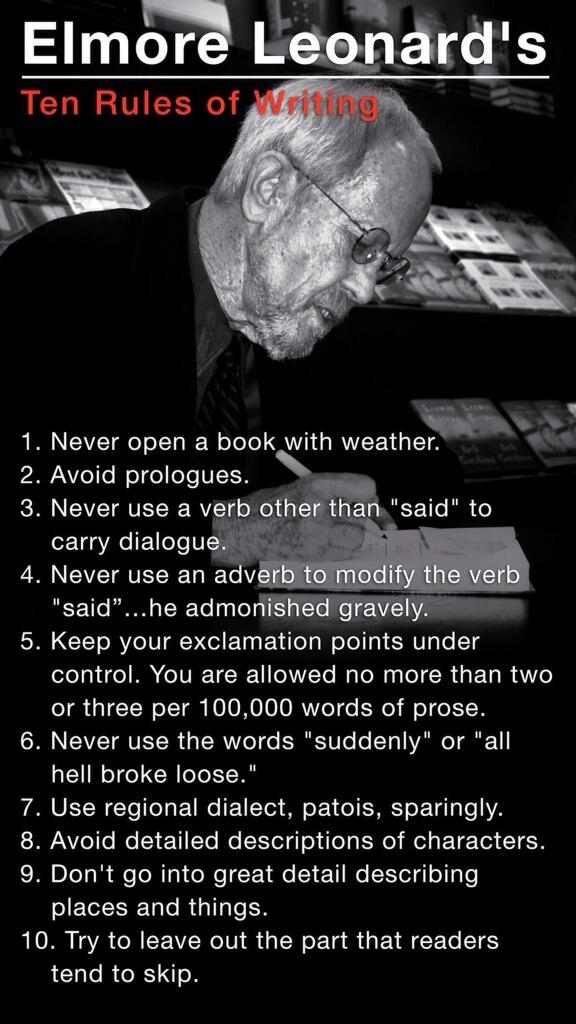
BVWqlvwCAAE7ORr.jpg

Here’s my opinion:

1. Personally, I love a story that starts with “It was a dark and stormy night…” (just kidding, unless the author is trying to be ironic).

2. How about the prologue? Is there a bit of the story that just needs to be set off by itself? I’m pretty sure I’ve never had a problem with a prologue.

3.”Said” seems to have no grey area. Writers either demand that “said” be used exclusivelyor they hate having to stick to “said.” Some say it’s the mark of an inexperienced writer to use words other than “said.” Whatever. Sometimes, words like “whispered,” “murmured,”or “shouted” just need to be used, I…


View original post 272 more words

Cut The Fat; Make Your Writing Lean: #Tip 27.

Writers share ideas to improve their craft. Here, I'm looking at ways to trim our writing. Readers will thank us for removing common redundancies and flabby expressions. Close proximity: Something in proximity to something else is close to it, so ‘close’ is a tautology. e.g. The close proximity of the backpacker caused the tourists to …

Continue reading Cut The Fat; Make Your Writing Lean: #Tip 27.