
Ray Bradbury was one of my earliest writer heroes. I read a lot of his work when I was a teenager and young man. Along with Asimov, Clarke, Aldiss, Heinlein and Wyndham he was one of the authors who created my love of science fiction.
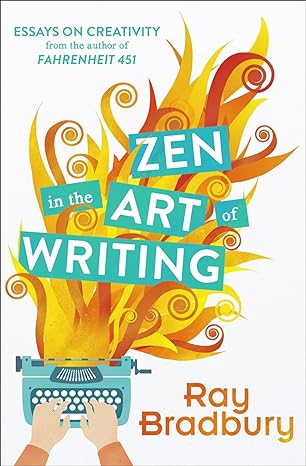
This is my second reading of this book. It has been revised a little since my first reading, way back in 2016, but the essentials remain unaltered. It consists of a series of dated essays that recount his experiences, influences, motivations and encounters as a writer.
You’ll find no advice on technique or marketing, language or grammar, story structure or characterisation in these pages, although some of these topics are tangentially referred to along the way. This is a book about what it is to be a writer, what drives that urge to put words on paper, what matters to the author.
I’ve been writing fiction in various forms for more years than I care to consider. Without knowing it in the early days, I’ve approached my writing in the same way Ray Bradbury approached his, except I lacked the luck to be writing in America at the time he started. It was the golden age of science fiction, when the reading public suddenly began to understand that, far from being a genre for kids who liked comic books, science fiction was and remains a field full of ideas, questions and possible solutions.
Interesting to note Ray advises his readers of this book to acquire a copy of another of my favourite writing books; ‘Becoming a Writer’ by Dorothea Brande. Along with the more recent work by Stephen King, ‘On Writing: A Memoir of the Craft’, these are the only books I urge would-be authors to read before they attempt their first work.
Re-reading this book has re-ignited my early enthusiasm for writing. Not that I ever lost it, but over the years, motivation can dim a little. Ray’s words of wisdom, written in his effortlessly poetic style, empower authors with his idea that the prime emotion you should feel when writing is excitement. If you feel this, the reader will be infected with the same exhilaration. And it’s true. No matter what the scene describes, the emotional state of the writer seeps onto the page, it’s about how the character feels. The writer’s state of mind creeps into the mind of the reader. That’s why honesty is fundamental to good fiction. Any attempt to dupe the reader with an author’s false feelings will seep onto the page and undo that effort.
I’m so pleased I came across this newer edition. Reading it again has inspired me to renew my approach to the work of the author, to ensure I enjoy the work and pass on my enthusiasm to my readers. Thank you, Ray Bradbury. I’ll now revisit your back catalogue and seek out those works of yours I didn’t read as a young man and see how many I can read now I’m older.

 Stuart Aken
Good grief. We read many of the same authors. I was introduced to them by my father, who was a huge sci-fi fan. I read them before I even got to high school, so I am not sure how much they influenced my writing.
LikeLiked by 1 person
Parents can be so influential, can’t they? My father was a real fan of H. Rider Haggard, but we had virtually no books in the house, everything came from the local library. By the age of eleven I’d exhausted the children’s section and had to approach the rather formidable lady librarian to ask if I could take books from the adult section. Because I’d always treated books with respect and taken them back within the loan period, she agreed I could. But I had to pass each book selected before her, only her. My first choice was Erich Maria Remarque’s ‘All Quiet on the Western Front’. Full of violence, swearing and prostitute activity, I assume she let me read it because it was a ‘classic’. After reading it, I realised I could probably borrow any book I wished, and she never refused any one I chose.
But I didn’t get to sci-fi until I was in my teens. We read H. G. Wells’ ‘The History of Mr. Polly’ as part of our ‘O’ level GCE exams, and that introduced me to his ‘Time Machine’ and ‘The Invisible Man’. From there, I discovered more of the genre, of course, but it was Ray Bradbury who really impressed me with is storytelling and the quality of his writing.
I guess, by that time, I was open to influence in my own writing.
LikeLiked by 1 person
My parents kept some books in the house -the sci-fi my father loved and also some nicely bound books including The Ilead and the Odyssey, which I read when I was probably ten or so.
LikeLiked by 1 person
Pretty advanced reading material for a ten-year-old, Noelle. Our experiences tend to demonstrate early reading is a definite influence on growing writers!
LikeLike
Absolutely!
LikeLiked by 1 person
Tried to add this comment to your review but don’t know if it “took.”
I, too, read tons of SF in my younger years, including the authors you mention, and more. Without my realizing it, I’m sure it shaped my approach to writing too. Wasn’t familiar with Bradbury’s “Zen . . .” book, however. I’ll have to look for it. To your list of good books on writing, I would add How to be a Fantastic Writer by Penny Grubb and Danuta Reah. Believe it or not, I always also recommend The Elements of Style by Strunk and White — helpful and a surprisingly good read!
LikeLiked by 1 person
It did, Walt.
I agree with you about Penny Grubb and Danuta Reah’s ‘How to be a Fantastic Writer, and ‘The Elements of Style’. Another two good books on writing among a genre that’s overloaded with the mediocre so often.
LikeLiked by 1 person
The Illustrated Man was the first sci-fi book I remember reading on my own.
LikeLiked by 1 person
It was one of my first, too, Leon. Taught me a lot about the use of language and imagery, that one.
LikeLiked by 1 person