

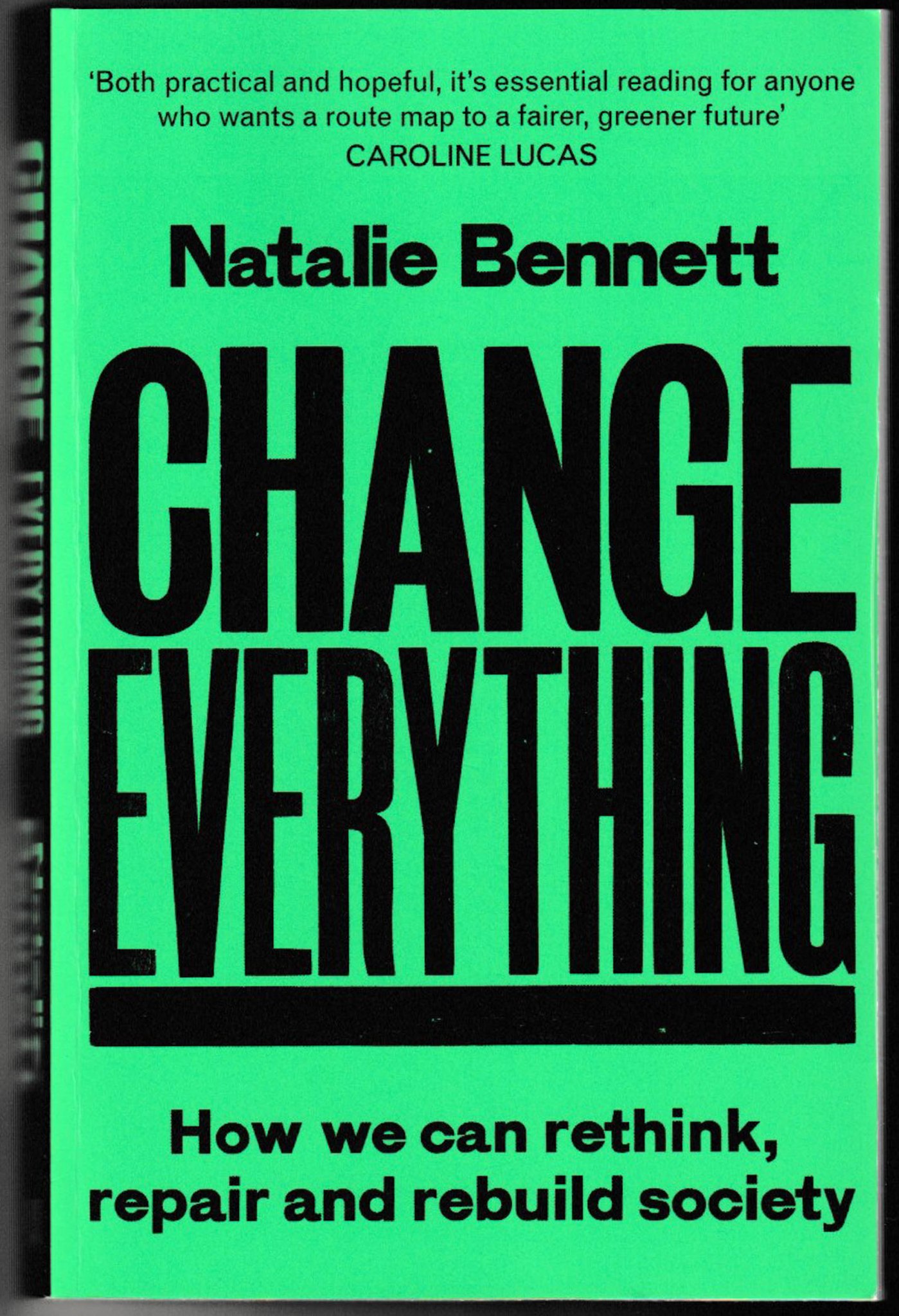
Subtitled ‘How we can rethink, repair and rebuild society’ this book deals comprehensively with issues and problems of our current political systems. It is essentially written about the situation in the UK but has a pretty universal application.
I’d like to have all our current, and potential, politicians made to sit down and read this manual for a fairer and more workable world.
The book starts with a comprehensive ‘Introduction to The World We Have Made’ and is then divided into four Parts:
Part A – ‘Active Freedom’, deals with Decommodifying Time; Education For All, For Free, For Life; and DIY Politics.
Part B – ‘True Prosperity’, deals with Restoring the Earth; The People’s Economy; and Controlling the Money.
Part C – ‘Healthy Life’, looks at Enabling Wellbeing; Unleashing Culture; and Recovering Space.
Part D – ‘Shared Resilience’, talks about Repairing the Broken; Rebalancing the World; and Making Reparation.
Natalie Bennett has worked and lived in a number of lands and cultures. It is clear she made extensive research for this inspiring attempt to change our world for the better. The work is fact-based, intelligent, thoughtful, inspiring, optimistic, and comprehensive. A real sense of justice permeates the narrative, with practical solutions to so many of our current problems, and ideas aimed at reducing the current conflict that is so destructive in our politics at present.
There is encouragement for those in society attempting, and often succeeding, at local politics that directly affect their lives and those of others.
She makes cogent points about the nature of leadership and how reliance on one leader is a recipe for disaster in so many ways. I could quote examples here, but everyone must be starkly aware of the many conflicts, both internally and globally, that stem from the vanity, greed, incompetence, and ignorance of many political leaders. It is surely time for a change.
This is essentially a manual for practical change to many aspects of our political, social, and cultural lives. A way to examine our prejudices, beliefs, concerns, and actions with the aim of producing a much fairer, more inclusive, rational, and universal society that creates a better world for all.
It is a relatively radical, but eminently practical approach to correct a whole raft of issues that currently not only lie unmanaged, but actually threaten our mental and physical health, our prosperity, our environment, and, ultimately, the continuation of human life on the planet.
I cannot recommend this book highly enough. Everyone should read it and gain hope from the content, especially all our politicians and leaders in all fields of endeavour. Carried to its logical conclusion, the philosophy described in this book could fundamentally change the whole world for the better.
[Any review is a personal opinion. No reviewer can represent the view of anyone else. The best we can manage is an honest reaction to any given book.]

 Stuart Aken
Thank you very much for suggesting this title, Stuart.
LikeLiked by 2 people
If only the whole world could adopt her ideas, Lynette, we’d all be a lot better off.
LikeLiked by 1 person
The will to do what’s needed is rather weak, unfortunately.
LikeLiked by 1 person
Very weak, unfortunately, Lynette, yet these changes really could make the whole world better for everyone, instead of the current system where only the wealthy, the very wealthy, get far more than they need. This book gives hope, if only more people would understand what the real problems are.
LikeLiked by 1 person
Agreed – the wealthy get far more than they need but I also think that much of the population of the wealthiest countries are extreme, outsized consumers.
You might be interested in watching the documentary “You Are What You Eat” (on Netflix). It’s basically about the fact that we eat too much meat but also looks at the implications of over-consumption on the planet, including resultant global warming.
Here’s an article about it: https://news.stanford.edu/report/2024/01/18/qa-christopher-gardner-featured-netflixs-eat/#:~:text=The%20Netflix%20series%20You%20Are%20What%20You%20Eat%20features%20Christopher,comparing%20vegan%20and%20omnivore%20diets.
I have always leaned towards vegetarianism for many reasons (including the use of factory farms) but more so now!
LikeLiked by 1 person
Thanks for the link, Lynette. We eat very little meat. Valerie has an odd condition that makes meat inedible for her, so I have it only occasionally. I’ve posted that article to my FB page. It has similar findings to an experiment conducted here by a pair of twin doctors a couple of years ago.
And, yes, overconsumption by the wealthiest countries is a significant factor relating to climate change. So many habits need to change.
LikeLiked by 1 person
You’re welcome, Stuart. I don’t eat meat (or fish or chicken) much, either. Happy veggies! 🥕 🥦
LikeLiked by 1 person
Added this to my Want to Read list in Goodreads.
LikeLiked by 1 person
Good to know, MrsWayfarer. The more people who read this, the more likely we are to get some positive changes made.
LikeLiked by 1 person