

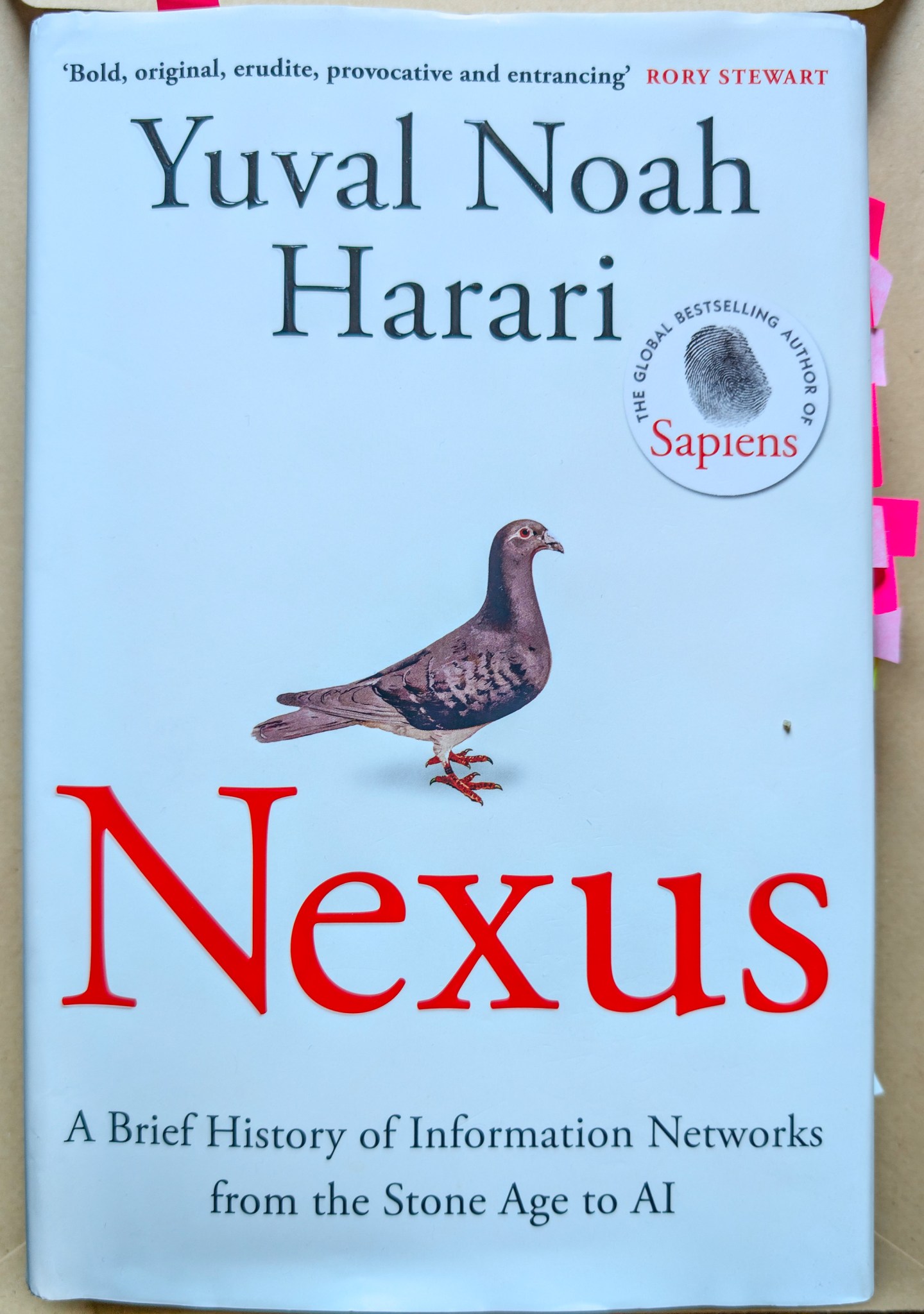
Subtitled ‘A Brief History of Information Networks from the Stone Age to AI, this weighty tome is actually surprisingly comprehensive. With 67 pages of Bibliography and an Index of 15 pages, the book is a veritable compendium of information, scholarly exploration, and informed opinion on the ways in which human societies have communicated over the period of their descent from the trees to modern times.
I have learned a great deal of history from this amazing work. Some of those things I thought I knew have been thrown into turmoil and then calmly explained in terms that have convinced me I was often wrongly informed. Alternatively, other aspects of my education, mostly gained through wide reading, have been confirmed as accurate, which is some relief. The amount of research involved in producing this book is astounding. And the breadth of knowledge, amalgamated and sorted into cohesive chunks, makes the reader question many opinions and commonly held beliefs, forming new views and surgically excising old ones. Presented in three parts, Human Networks, The Inorganic Network, and Computer Politics, followed by an Epilogue that explains how the author approached the subject and garnered expert help from many sources to supplement his already deep historical familiarity, the book covers more or less everything we need to consider in regard to the way we communicate.
The book is timely for a number of reasons that shouldn’t need clarification, but which will for many people. For a start, we are fast approaching the existential threat of uncontrollable climate change. Our political world is also in danger of falling prey to populist dictators who have no concern for anyone but themselves and their own glorification. And our technicians are experimenting dangerously with an increasingly threatening invention with the misleading label ‘Artificial Intelligence’.
Science Fiction writers (including me) have written copious warnings about this new development. Human beings have a strangely self-destructive tendency to invent things that threaten our continued existence. The nuclear bomb and biological warfare come to mind most easily. It is as if we are content to allow the development of these threats without ever stopping to question the wisdom of such so-called advances. Perhaps it is time to take a pause for breath in our dash toward potential suicide and just ask ourselves a simple question: ‘What are the real potential consequences of this development?’
Harari is remarkably neutral in his analysis of the problems we are creating for our future. He approaches from an academic, unemotional, point of view. But there lurks in the background the knowledge of the underlying threat to our very existence. The computing world, with its vested interest in creating what are frequently misnamed ‘advances’, is mostly silent on the issue of threat when it comes to AI. They tell us it is unlikely to become self-aware and therefore not likely to use its logic to determine that we are a wasteful species the world would be better without. But there are other aspects to AI, especially as it applies to the many algorithms that now rule much of our online and ordinary daily lives. Applying AI to these ubiquitous processes has every likelihood of resulting in significant conflict between individuals, groups and nations. Harari explains this in much more convincing terms than I can in this short review.
If you read the book for no other purpose than to understand the implications of AI for our future as a species, please, at least read it for that reason. Because tomorrow it may be too late.

 Stuart Aken
Pingback: Nexus, by Yuval Noah Harari: #BookReview. | Rashid's Blog: Portal for Inquisitive Learners
Sounds like a good, informative read.
LikeLiked by 1 person
Yes, Noelle, the breadth and depth of the information covered is quite remarkable.
LikeLiked by 1 person