

In this rolling series I’m looking at things seen when out walking. Some objects will be familiar to some readers, but many are likely to be unfamiliar to most. I’m presenting those that caught my attention through incongruity, idiosyncrasy, or simply their odd appearance.
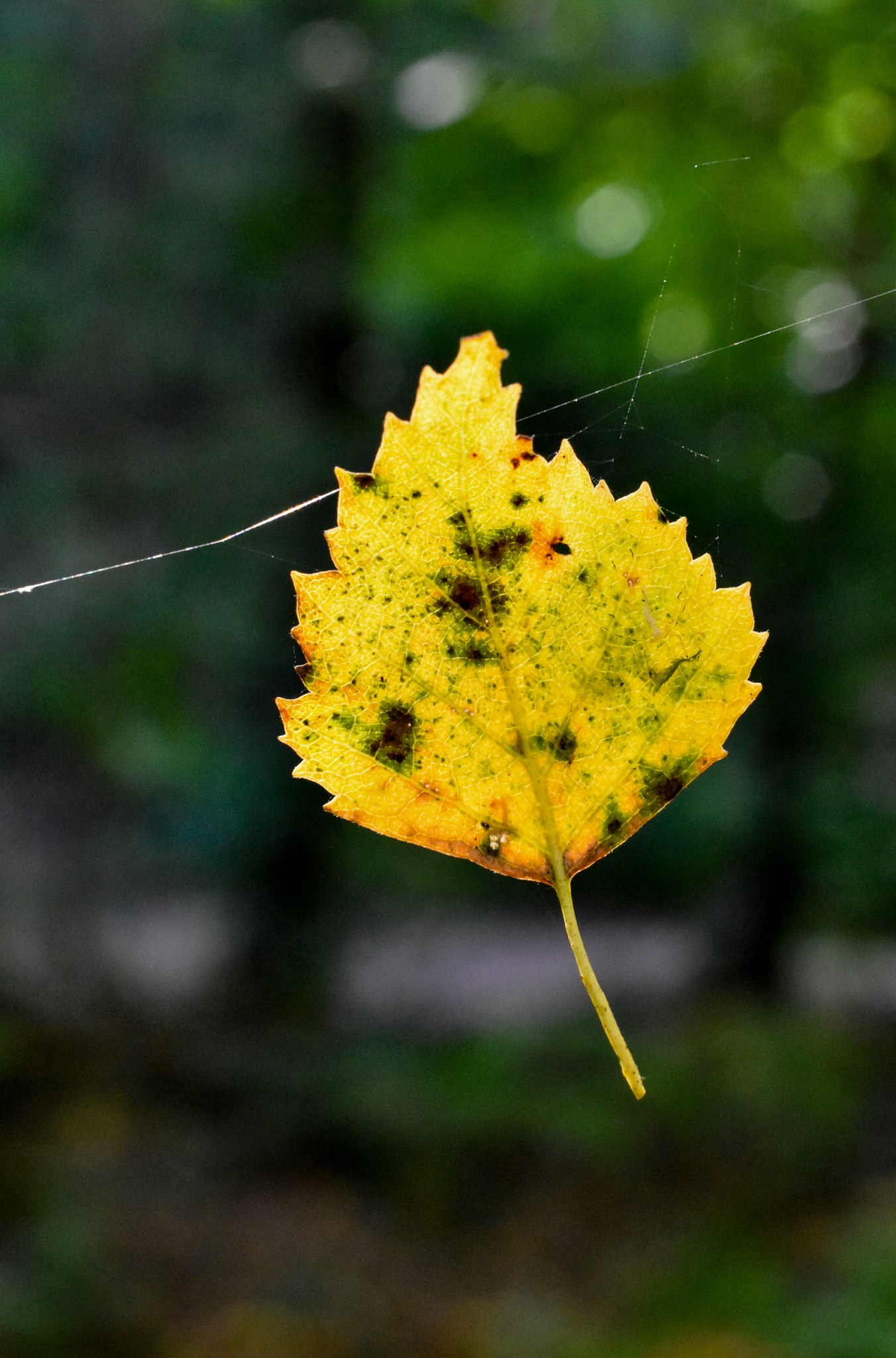
I came upon this birch leaf on an autumn walk through the Forest of Dean. On approach, it gave the impression it was hovering completely unsuspended against the dark background of shaded trees. Only as I moved closer did I see the spider’s web strands in which it had been caught.
This sparked two lines of thought. First, just how strong the spider’s web must be to catch and retain this object without breaking in the wind. And, secondly, how easy it is for the human eye/mind to be fooled when presented with something unexpected and apparently impossible. It set me to wondering if the many tales and legends of wondrous creatures of the wild sprang from sightings of perfectly ordinary animals viewed in similarly confusing circumstances at a time when people were unable or unwilling to follow-up such sightings through fear and/or superstition.
Of course, we still experience such sightings today. Every county has its black panther that’s actually a labrador dog seen in unusual circumstances, or its ‘lion’ that’s really only a large ginger tom seen in a place devoid of items to give it scale.
We often ‘see’ odd ‘creatures’ as we walk the woods, knowing they’ll quickly become identifiable as combinations of perfectly ordinary things seen from a distance, often in shadow. As we approach, we wonder how our brains could’ve been so easily fooled into seeing the end of a fallen log, coupled by distance with some dying vegetation, as a boar, a dog, a rabbit, etc. It always makes us smile as we pass the separate items and see them for what they really are.

 Stuart Aken
You write so eloquently and thoughtfully about our tendency to misunderstand. Narrowing the distance – no matter the form of miscommunication – often alleviates the issue. Cheers.
LikeLiked by 1 person
Ah, you’ve discovered my sub-text, Lynette. Not really a surprise, knowing how bright you are.
The human brain has a tendency to form patterns when faced with something it can’t quite determine on first sight. It’s an overhang of our survival technique when we lived in the wild and our ability to spot a predator meant the difference between life and death!
Trouble is, most of us no longer live in that world, but the gene memory remains and sometimes fools us.
LikeLiked by 1 person
Thank you, Stuart. 😊
LikeLiked by 1 person