

This is the second in a proposed series on peculiarities I’ve encountered when walking. I originally intended these posts to appear only on Medium, but that’s a platform where most readers subscribe with a small annual fee for the opportunity to read from a vast collection of posts covering an enormous range of interests. It allows authors to be rewarded for their time and effort. But it’s quickly become clear many of my regulars don’t belong to Medium, so I’ve decided to post the series here as well.
If you missed the first post, which explains the premise, you can find it here on Medium. And, for those not on the other platform, I’ll repeat the introduction here:
‘When I’m out and about, whether in urban chaos or rural tranquillity, I’m often attracted by the odd, the misplaced, the unusual, the item that smacks the eye with its inappropriate situation; probably something to do with being odd myself, eh?
It seems, since I tend to record such encounters on whatever recording device I’m carrying, a good idea to share these oddities with a wider audience to see what others take from them. Who knows, might we learn something? And, even if we don’t, some of the images will amuse, some will shock, some may cause possible disgust, and all invite comment or even discussion. So, nothing to lose, I think.’
On to today’s post:
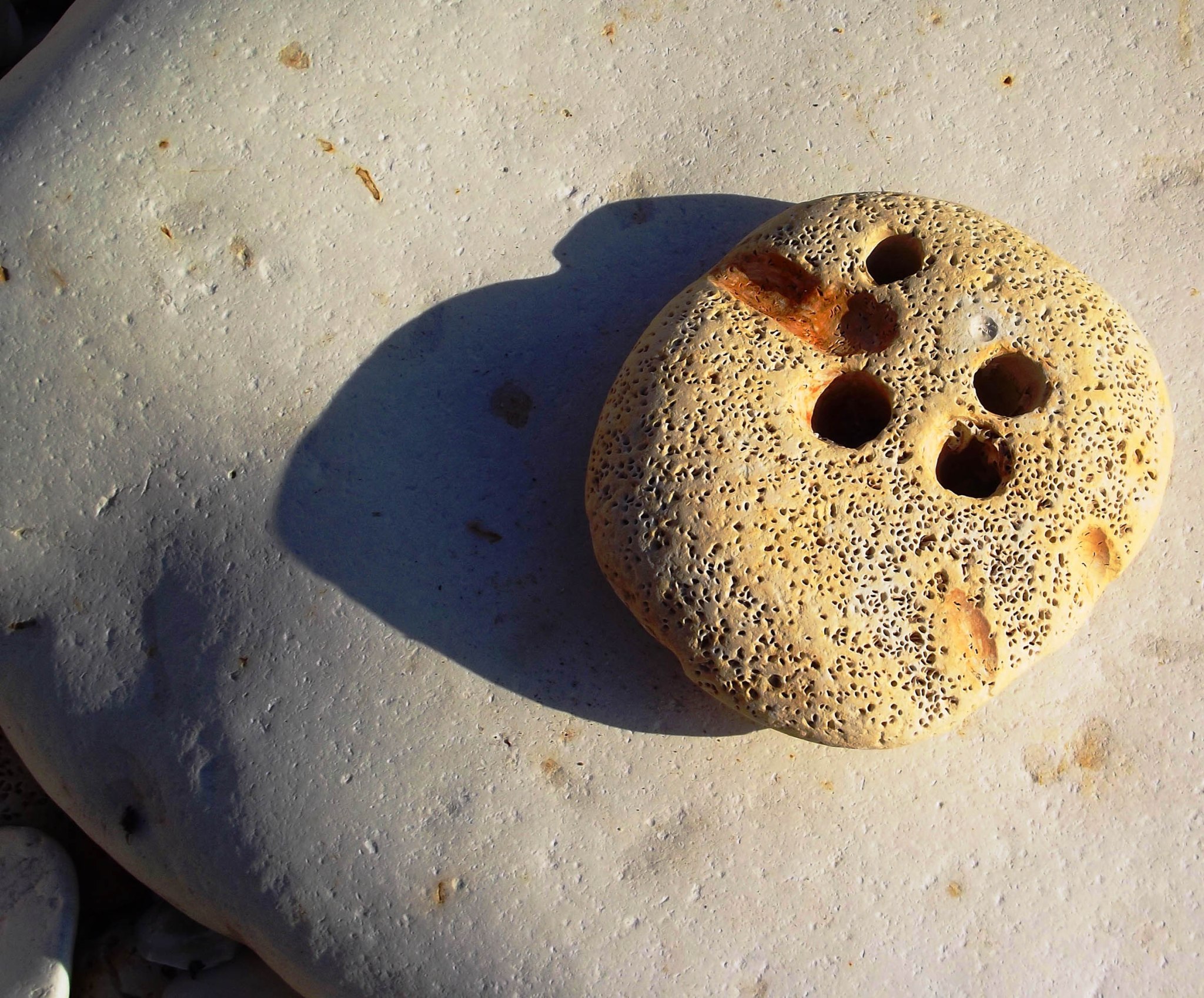
I guess we’ve all encountered beach stones with odd holes bored in them, and wondered how they came by these strangely perfect decorations. Believe it or not, they’re created by a small bivalve mollusc (in other words, a shellfish), called Pholas dactyl. But, known more colloquially as the common piddock. Mind you, I’m not sure I’d want a moniker that labelled me a lower-class twit.
Of course, it does have an even less complimentary popular name, which is the nominative deterministic ‘boring piddock’. I mean, hardly likely to elevate self-confidence, is it?
But enough about the name.
How does this wee beastie perform its apparent miracles?
It’s small and needs a shell to protect its fragile body from attack. So, how does it bore holes in solid rock? Apparently, although its shell is thin and brittle, the design is such that it can withstand unusual pressures. And the small inhabitant has a locking sucker-like foot that anchors it to the selected stone. It then twists and twists, and the thousands of tiny file-like rasps that coat the shell allow it to slowly drill into the stone. Isn’t nature amazing? Once attached within its hole, it is safer from attack, it seems.

 Stuart Aken
Well, I’d always assumed they were created by the sea eroding geological weak spots in the rock. Learn something everyday! Thanks Stuart
LikeLiked by 1 person
I’d made the same assumption, Penny, especially after witnessing similar boreholes in rocks near the base of freshwater waterfalls. Those, it seems may well be caused by erosion, but it’s the good old boring piddock that makes those holes at sea.
LikeLiked by 1 person
I knew about these little marine critters. That stone seems popular as it’s covered in many smaller holes, as well. Other, tinier creatures looking for homes or possibly just the composition of the stone itself wearing down? Interesting.
LikeLiked by 1 person
This particular stone was found on a pebble beach below chalk cliffs, Lynette, so the rock was probably relatively soft and therefore available to the smallest of these creatures to inhabit.
LikeLiked by 1 person
You’ve solved a mystery for me!
LikeLiked by 1 person
That’s good to know, Noelle. Glad I’ve been able to illuminate a mystery.
LikeLiked by 1 person
I always wondered about that. Very interesting.
LikeLiked by 1 person
They are distinctly odd, aren’t they, Liz? A friend of mine who was a biology teacher first told me they were called ‘boring piddocks’, a name that has continued to amuse me.
LikeLiked by 1 person
Yes, they are odd.
LikeLiked by 1 person